
CampusDiscover - Campus info & social discovery App
CampusDiscover - Campus info & social discovery App
End-to-End Product Design (UX) Case Study
End-to-End Product Design (UX) Case Study
Turning a cluttered bulletin board into a campus-only, mobile-first social product with clear categories, search, and quick posting to create a clearer path to action.
Turning a cluttered bulletin board into a campus-only, mobile-first social product with clear categories, search, and quick posting to create a clearer path to action.

“I wish this were a real app.” — Prototype testing participant
“I wish this were a real app.” — Prototype testing participant
CampusDiscover - Campus info & social discovery App
End-to-End Product Design (UX) Case Study
Turning a cluttered bulletin board into a campus-only platform with clear categories, search, and quick posting to create a clearer path to action.
“I wish this were a real app.” — Prototype testing participant
Project Overview
Project Overview
Project Overview
Project type
Project type
Mobile
Mobile App
Mobile App
Project type
Timeline
Timeline
Timeline
Nov - Dec 2025 (2 months)
Nov - Dec 2025 (2 months)
Nov - Dec 2025 (2 months)
Role
Role
Role
UX Designer, UX Researcher
UX Designer, UX Researcher
UX Designer, UX Researcher
Challenges
Challenges
Challenges
Complete an end-to-end product design within a limited two-month timeline while working on two projects concurrently.
Complete an end-to-end product design within a limited two-month timeline while working on two projects concurrently.
Complete an end-to-end product design within a limited two-month timeline while working on two projects concurrently.
Design a feature that creates clear product differentiation while making trade-offs across multiple design concepts.
Design a feature that creates clear product differentiation while making trade-offs across multiple design concepts.
Design a feature that creates clear product differentiation while making trade-offs across multiple design concepts.
Design for two goals, campus information discovery and a low-pressure icebreaker feature that helps students connect and meet new people.
Design for two goals, campus information discovery and a low-pressure icebreaker feature that helps students connect and meet new people.
Design for two goals, campus information discovery and a low-pressure icebreaker feature that helps students connect and meet new people.
What I learned
What I learned
What I learned
I got better at balancing priorities across two projects by running research during the day when participants were available and using nights for independent design work.
I got better at balancing priorities across two projects by running research during the day when participants were available and using nights for independent design work.
I got better at balancing priorities across two projects by running research during the day when participants were available and using nights for independent design work.
With limited time and a small sample, I learned to use multiple research methods to quickly validate early insights and keep the project moving.
With limited time and a small sample, I learned to use multiple research methods to quickly validate early insights and keep the project moving.
With limited time and a small sample, I learned to use multiple research methods to quickly validate early insights and keep the project moving.
In complex UI screens, I learned to improve visual hierarchy by testing different approaches and making sure the primary content gets the most attention.
In complex UI screens, I learned to improve visual hierarchy by testing different approaches and making sure the primary content gets the most attention.
In complex UI screens, I learned to improve visual hierarchy by testing different approaches and making sure the primary content gets the most attention.
Keeping frequent self-reviews and owning my mistakes helped me catch issues early and learn faster.
Keeping frequent self-reviews and owning my mistakes helped me catch issues early and learn faster.
Keeping frequent self-reviews and owning my mistakes helped me catch issues early and learn faster.
Background
Background
Background
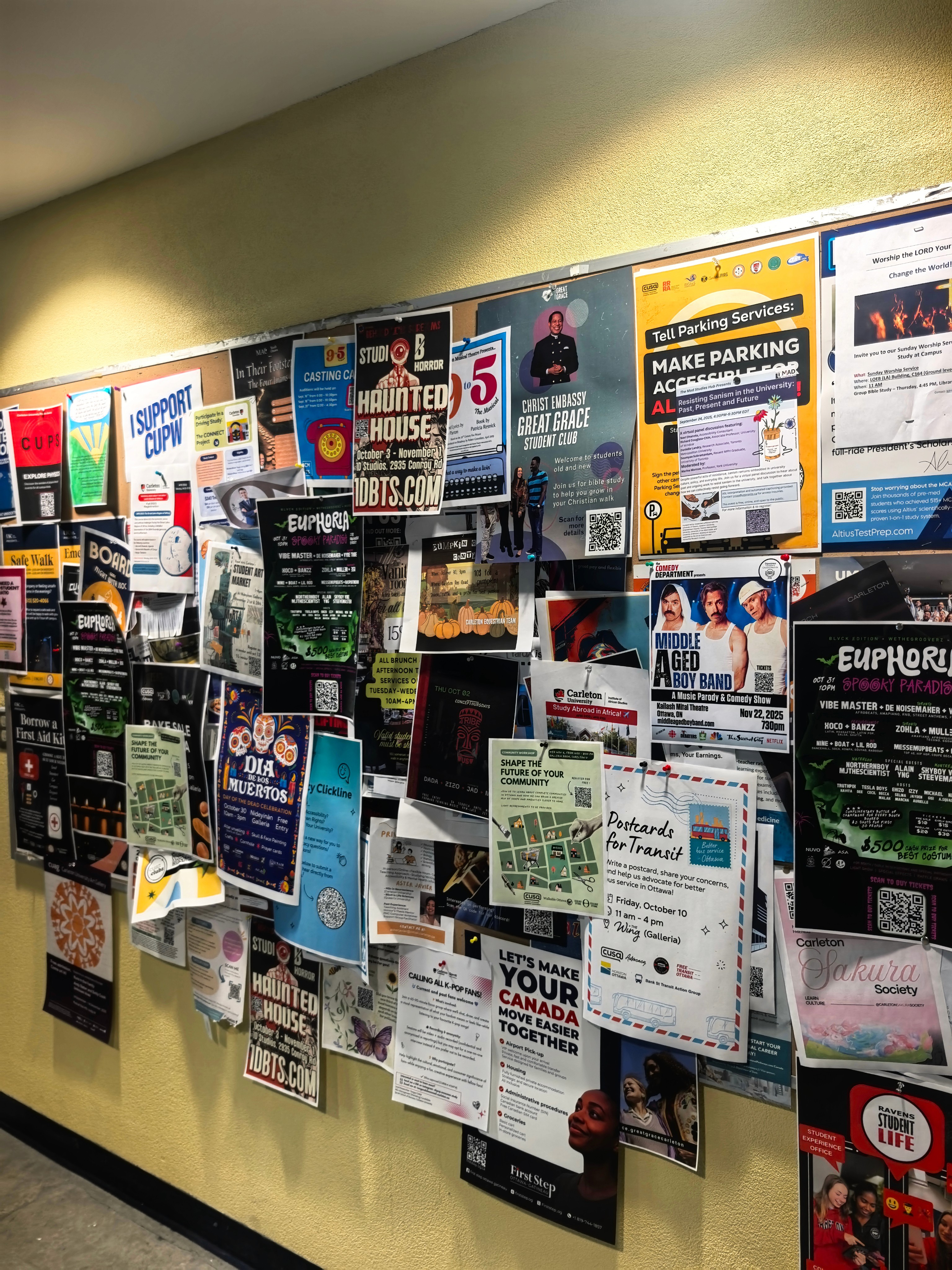
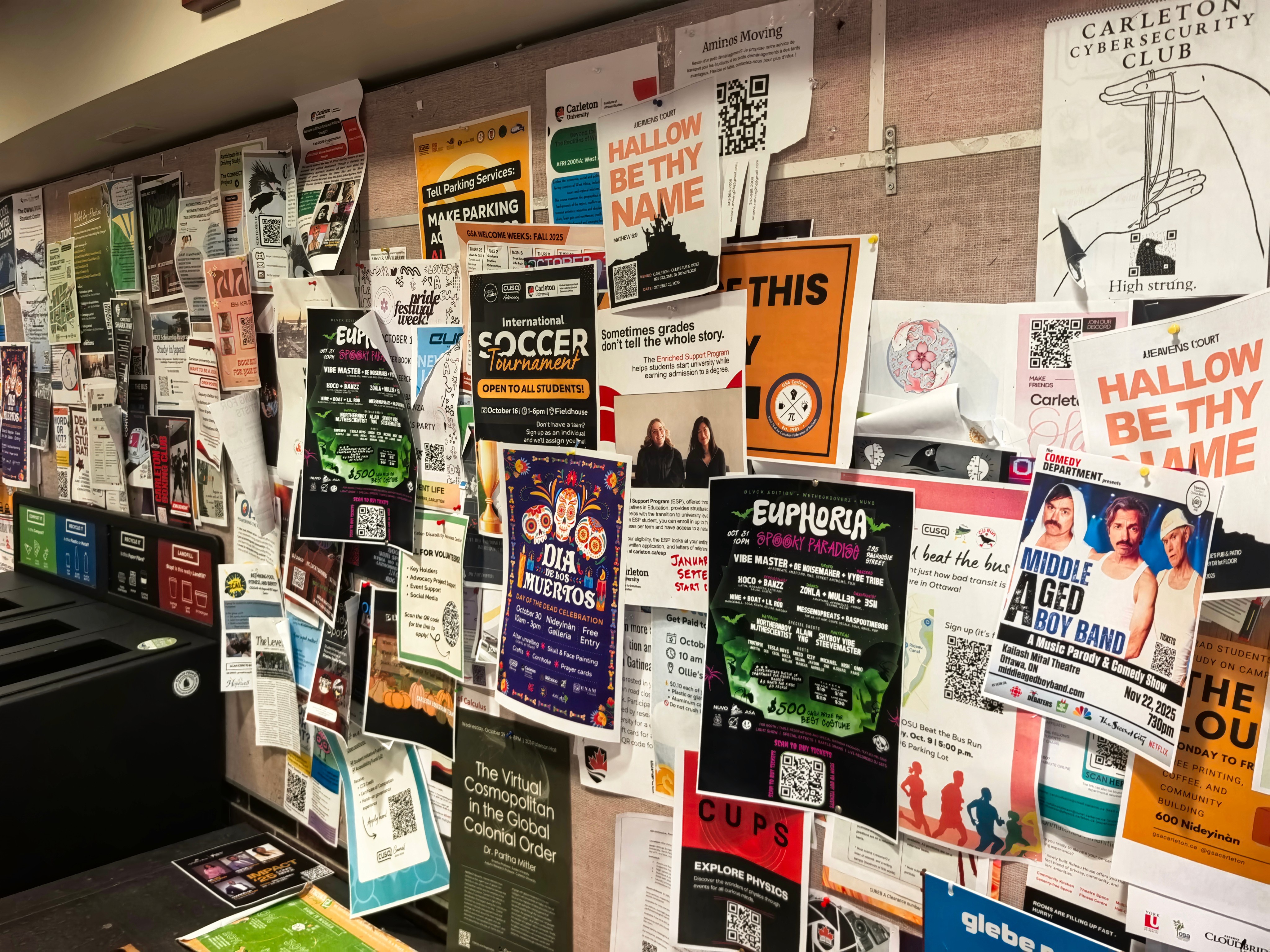
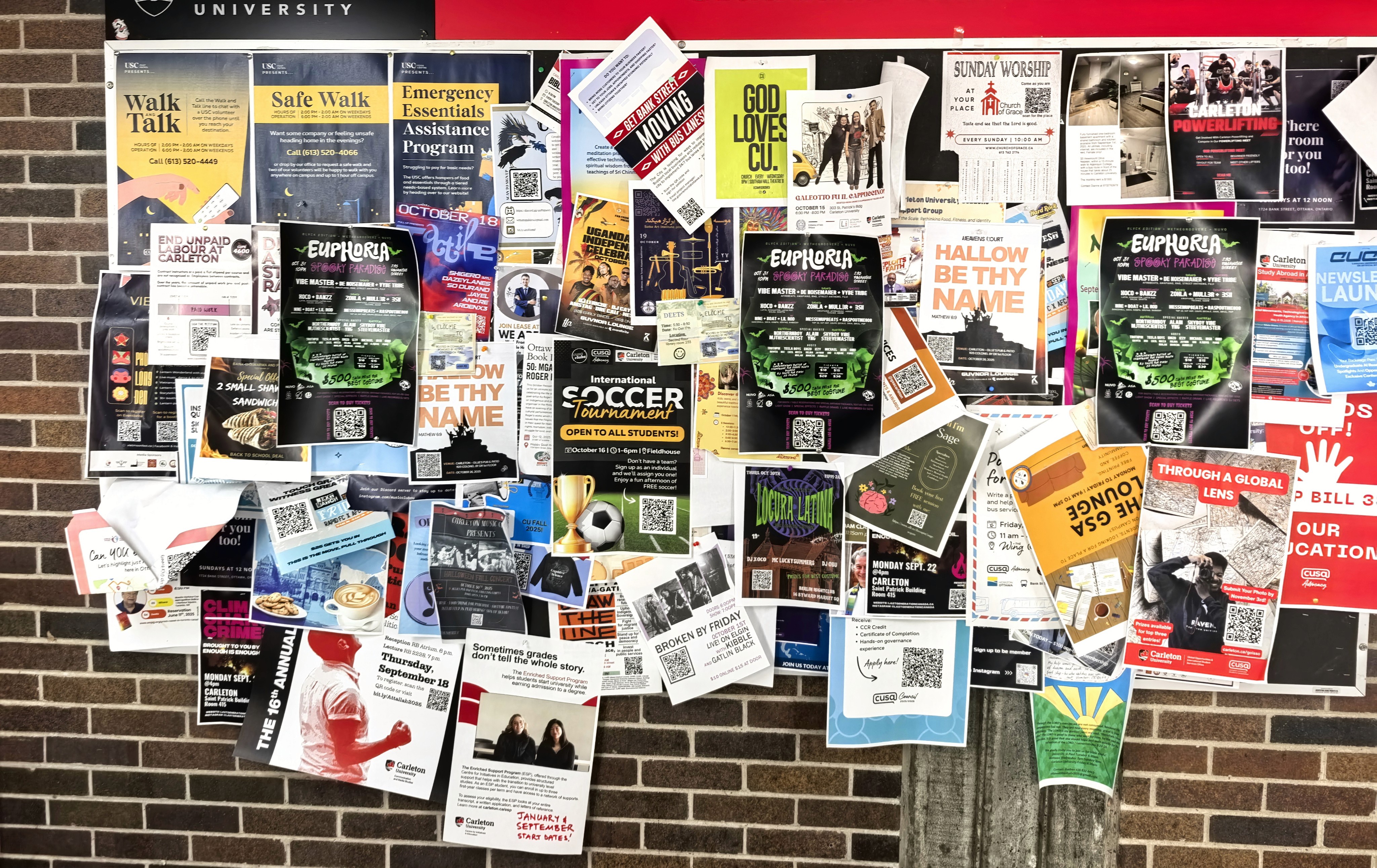
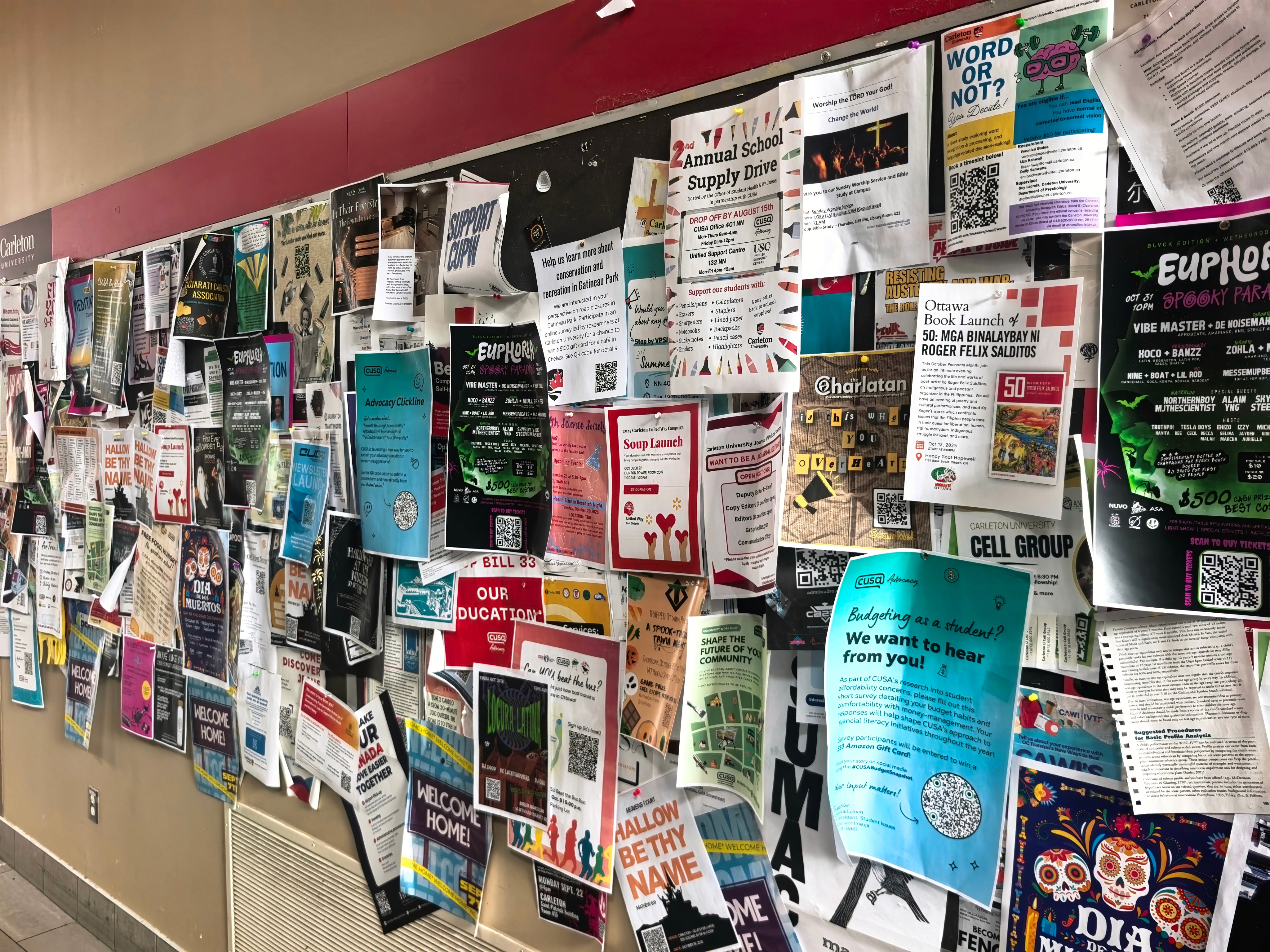
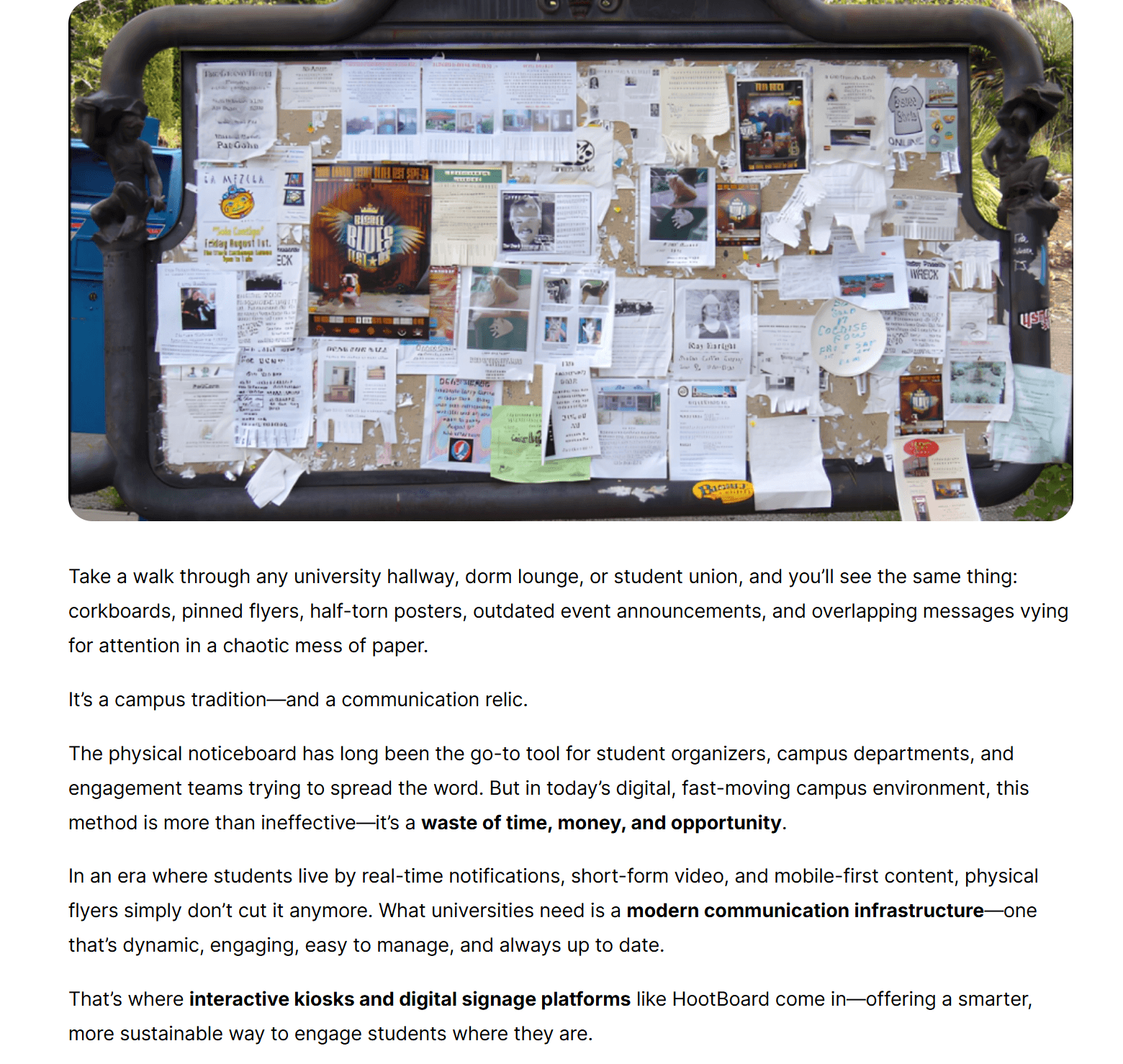
When I visited Carleton University, I kept walking past bulletin boards where new posters were pinned directly over old ones. Layers of overlapping posters turned the boards into visual noise, crammed with all kinds of messages.
When I visited Carleton University, I kept walking past bulletin boards where new posters were pinned directly over old ones. Layers of overlapping posters turned the boards into visual noise, crammed with all kinds of messages.
When I visited Carleton University, I kept walking past bulletin boards where new posters were pinned directly over old ones. Layers of overlapping posters turned the boards into visual noise, crammed with all kinds of messages.

Research Goals
Research Goals
Research Goals
To understand how campus bulletin boards are used as an information channel, how students notice or ignore them, where things break down in how students receive information, and how these issues can be turned into practical opportunities.
To understand how campus bulletin boards are used as an information channel, how students notice or ignore them, where things break down in how students receive information, and how these issues can be turned into practical opportunities.
To understand how campus bulletin boards are used as an information channel, how students notice or ignore them, where things break down in how students receive information, and how these issues can be turned into practical opportunities.
Research Methods Overview
Research Methods Overview
Research Methods Overview
1
1
1
Field Observations
Field Observations
Field Observations
Observed real behavior to identify problems.
Observed real behavior to identify problems.
Observed real behavior to identify problems.
2
2
2
Semi-Structured Interviews
Semi-Structured Interviews
Semi-Structured Interviews
Interviewed students to uncover pain points and understand their needs and motivations.
Interviewed students to uncover pain points and understand their needs and motivations.
Interviewed students to uncover pain points and understand their needs and motivations.
3
3
3
Secondary Research
Secondary Research
Secondary Research
Secondary research to validate the problems and check for potential sampling bias.
Secondary research to validate the problems and check for potential sampling bias.
Secondary research to validate the problems and check for potential sampling bias.
Field Observations
Field Observations
Field Observations
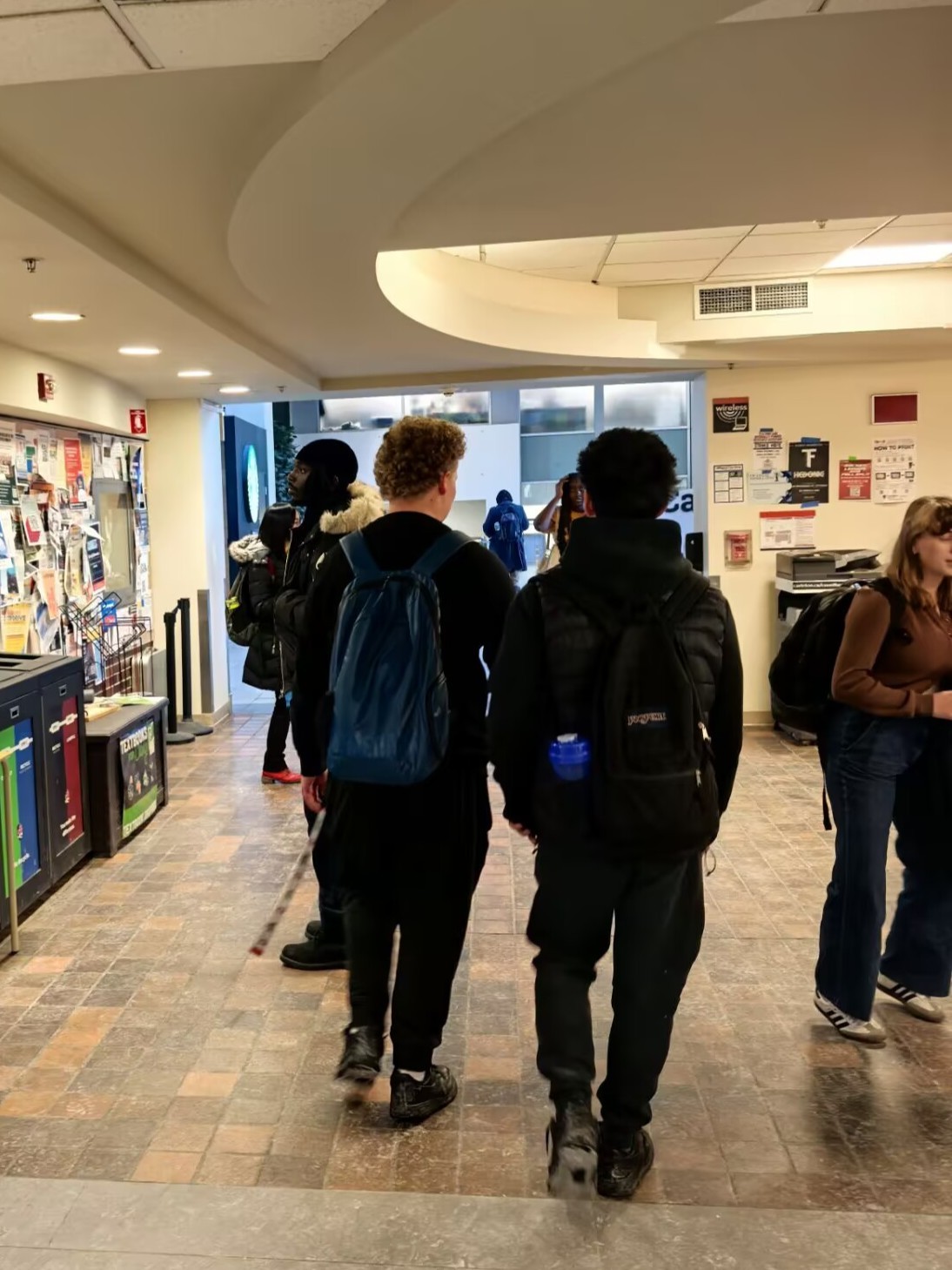
Cross-sectional Observations (Busy Times of Day)
Cross-sectional Observations (Busy Times of Day)
Cross-sectional Observations (Busy Times of Day)
Key Findings
Key Findings
Key Findings
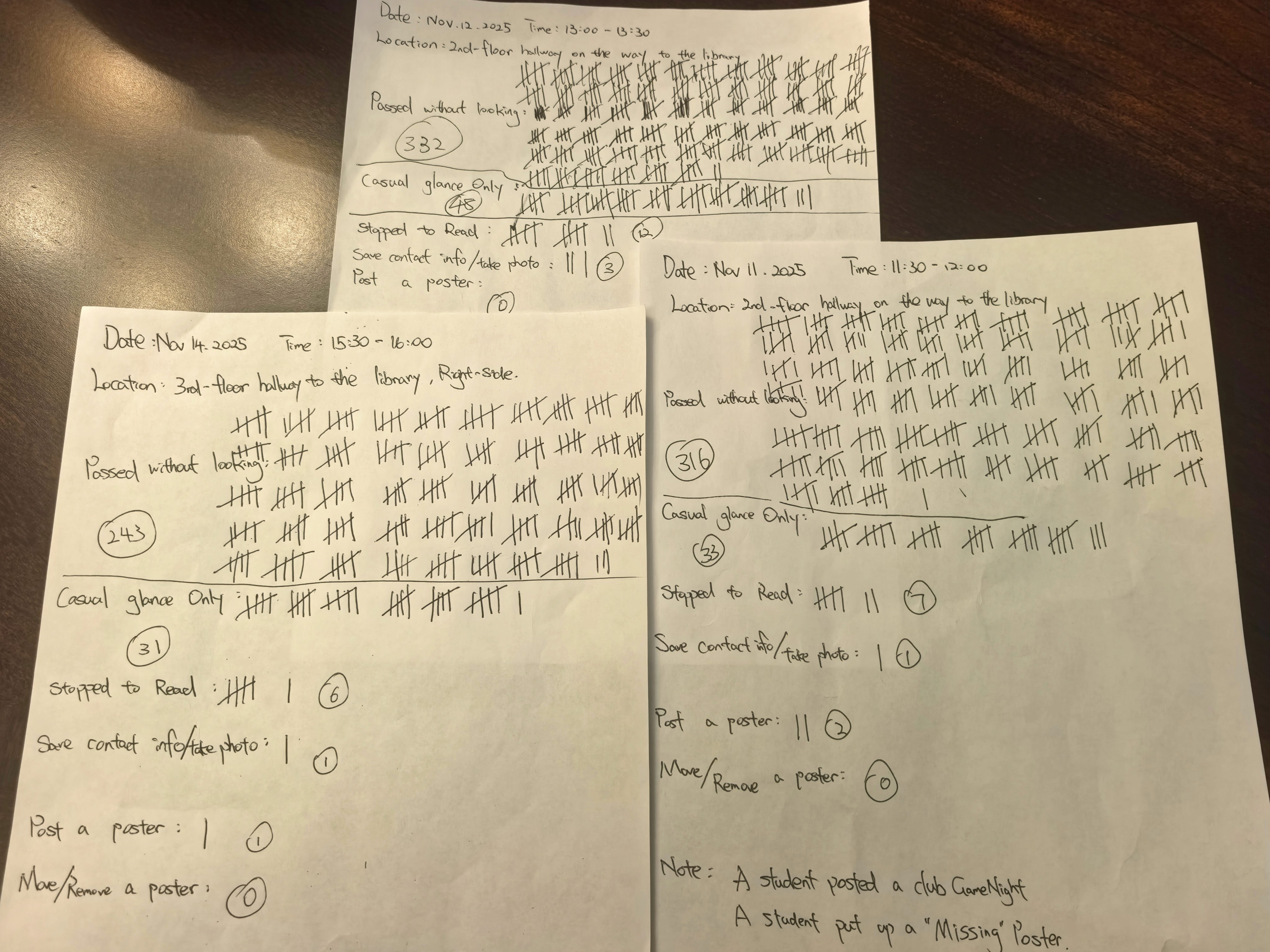
Across three observation sessions (n = 1,033):
Across three observation sessions (n = 1,033):
Across three observation sessions (n = 1,033):
86% of students walked past the bulletin board without looking
86% of students walked past the bulletin board without looking
86% of students walked past the bulletin board without looking
10.8% only glanced at it and then moved on
10.8% only glanced at it and then moved on
10.8% only glanced at it and then moved on
2.4% stopped to read
2.4% stopped to read
2.4% stopped to read
0.5% took a follow-up action such as taking a photo or saving contact details
0.5% took a follow-up action such as taking a photo or saving contact details
0.5% took a follow-up action such as taking a photo or saving contact details
1000
1000
1000
800
800
800
600
600
600
400
400
400
200
200
200
0
0
0
891
891
891
112
112
112
25
25
25
5
5
5
Number of students
Number of students
Number of students
Walked past
Walked past
Walked past
Glanced
Glanced
Glanced
Stopped
Stopped
Stopped
Took follow-up action
Took follow-up action
Took follow-up action
Key Insights
Key Insights
Key Insights
These numbers show that while the bulletin board reaches many students, it drives almost no action. Overlapping, unorganized posters create high cognitive load, so students default to ignoring the board, and it fades into the background instead of serving as a reliable source of information.
These numbers show that while the bulletin board reaches many students, it drives almost no action. Overlapping, unorganized posters create high cognitive load, so students default to ignoring the board, and it fades into the background instead of serving as a reliable source of information.
These numbers show that while the bulletin board reaches many students, it drives almost no action. Overlapping, unorganized posters create high cognitive load, so students default to ignoring the board, and it fades into the background instead of serving as a reliable source of information.
Short-term Longitudinal Observations (1–3 Weeks)
Short-term Longitudinal Observations (1–3 Weeks)
Short-term Longitudinal Observations (1–3 Weeks)

Week 1
Week 1
Week 1
Week 2
Week 2
Week 2

Week 3
Week 3
Week 3

Overflow onto entrance doors
(Week 3, nearby location)
Overflow onto entrance doors
(Week 3, nearby location)
Overflow onto entrance doors
(Week 3, nearby location)
Key Findings
Key Findings
Key Findings
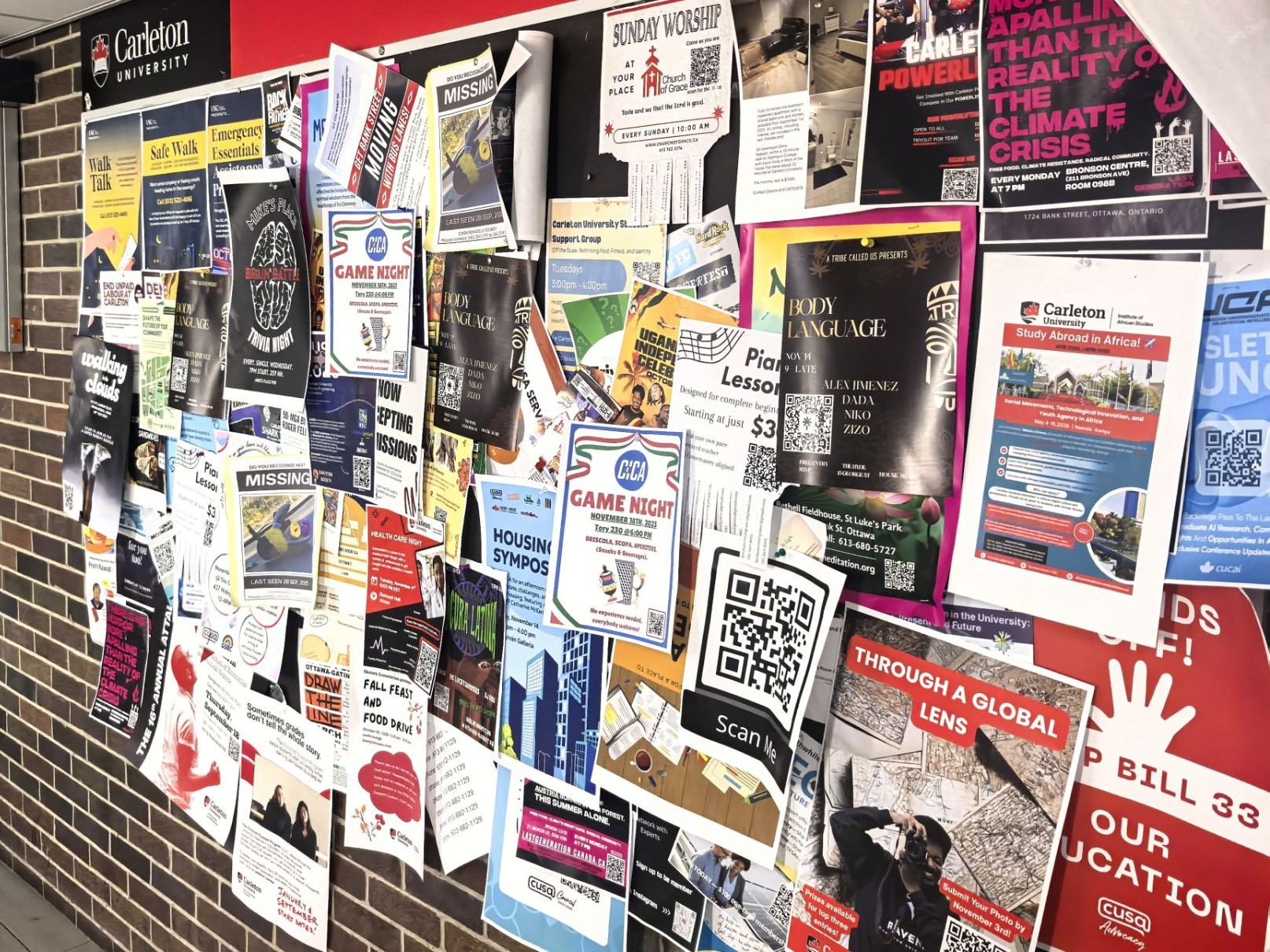
Over three weeks, old posters remained on the board while new ones were layered over them, competing for limited space, and by the third week, posters had also begun to appear on the nearby glass entrance doors.
Over three weeks, old posters remained on the board while new ones were layered over them, competing for limited space, and by the third week, posters had also begun to appear on the nearby glass entrance doors.
Over three weeks, old posters remained on the board while new ones were layered over them, competing for limited space, and by the third week, posters had also begun to appear on the nearby glass entrance doors.
Key Insights
Key Insights
Key Insights
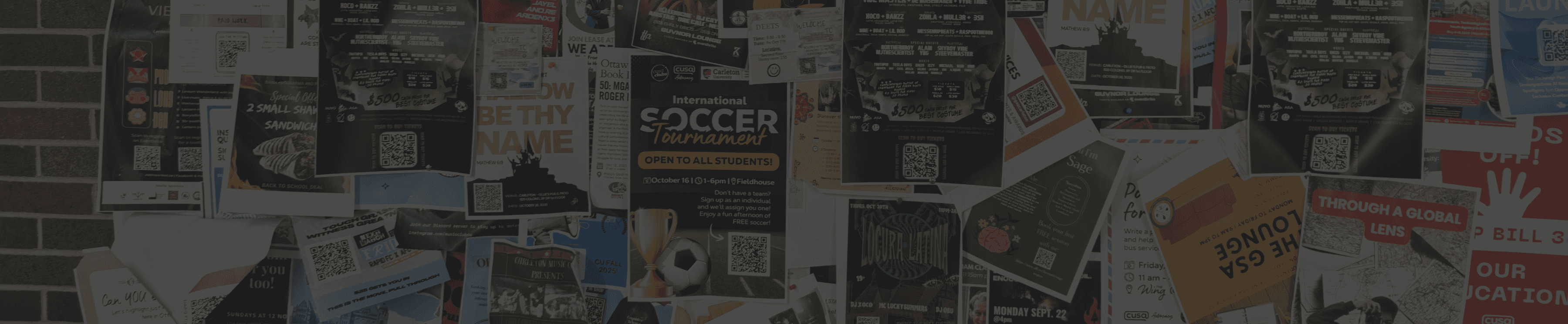
Students have a strong need to post and share information. The bulletin boards are always full. But finding information does not work well. Posters get covered quickly, visibility is unpredictable, and there are no categories to browse. This makes time-sensitive needs like housing and events easy to miss.
Students have a strong need to post and share information. The bulletin boards are always full. But finding information does not work well. Posters get covered quickly, visibility is unpredictable, and there are no categories to browse. This makes time-sensitive needs like housing and events easy to miss.
Students have a strong need to post and share information. The bulletin boards are always full. But finding information does not work well. Posters get covered quickly, visibility is unpredictable, and there are no categories to browse. This makes time-sensitive needs like housing and events easy to miss.
Problem Statement
Problem Statement
Problem Statement
The campus bulletin board looks full of information, but most students walk past without really browsing it, and new posts are quickly covered with almost no visibility or impact.
The campus bulletin board looks full of information, but most students walk past without really browsing it, and new posts are quickly covered with almost no visibility or impact.
The campus bulletin board looks full of information, but most students walk past without really browsing it, and new posts are quickly covered with almost no visibility or impact.
Semi-Structured Interviews
Semi-Structured Interviews
Semi-Structured Interviews
To better understand these observations, I conducted semi-structured interviews with students (n = 5) who were either putting up posters or walking past the board and agreed to participate.
To better understand these observations, I conducted semi-structured interviews with students (n = 5) who were either putting up posters or walking past the board and agreed to participate.
To better understand these observations, I conducted semi-structured interviews with students (n = 5) who were either putting up posters or walking past the board and agreed to participate.
The interviews explored how they notice and use the bulletin board, how they find and share campus information, and what response they expect versus actually receive after posting.
The interviews explored how they notice and use the bulletin board, how they find and share campus information, and what response they expect versus actually receive after posting.
The interviews explored how they notice and use the bulletin board, how they find and share campus information, and what response they expect versus actually receive after posting.
Key Findings
Key Findings
Key Findings
Information overload makes relevant content hard to notice
Information overload makes relevant content hard to notice
Information overload makes relevant content hard to notice
Students said they usually only glance at the bulletin board, and because posters are layered and unrelated, they often miss the information they actually need.
Students said they usually only glance at the bulletin board, and because posters are layered and unrelated, they often miss the information they actually need.
Students said they usually only glance at the bulletin board, and because posters are layered and unrelated, they often miss the information they actually need.
Posting is high-effort and low-return
Posting is high-effort and low-return
Posting is high-effort and low-return
Students said posters take too much work to design, and when no one responds, they move to Instagram and Discord.
Students said posters take too much work to design, and when no one responds, they move to Instagram and Discord.
Students said posters take too much work to design, and when no one responds, they move to Instagram and Discord.
Posters are a tool for connection, not just promotion
Posters are a tool for connection, not just promotion
Posters are a tool for connection, not just promotion
Students said they put up club or event posters mainly to meet new people and see if they click, the event details are secondary.
Students said they put up club or event posters mainly to meet new people and see if they click, the event details are secondary.
Students said they put up club or event posters mainly to meet new people and see if they click, the event details are secondary.
Students want a campus only for housing and second-hand items
Students want a campus only for housing and second-hand items
Students want a campus only for housing and second-hand items
Students mentioned that open platforms like Facebook Marketplace feel risky, and they feel safer making deals with fellow students on campus.
Students mentioned that open platforms like Facebook Marketplace feel risky, and they feel safer making deals with fellow students on campus.
Students mentioned that open platforms like Facebook Marketplace feel risky, and they feel safer making deals with fellow students on campus.
Discovery has moved to mobile, but campus info is fragmented
Discovery has moved to mobile, but campus info is fragmented
Discovery has moved to mobile, but campus info is fragmented
Students shared that they now use their phones, mainly social apps, to share events, surveys, and items for sale instead of the physical bulletin board. Unless they follow the right accounts or join the right groups, they often miss the information they need.
Students shared that they now use their phones, mainly social apps, to share events, surveys, and items for sale instead of the physical bulletin board. Unless they follow the right accounts or join the right groups, they often miss the information they need.
Students shared that they now use their phones, mainly social apps, to share events, surveys, and items for sale instead of the physical bulletin board. Unless they follow the right accounts or join the right groups, they often miss the information they need.

Key Insights
Key Insights
Key Insights
There’s an opportunity for a campus-only, mobile-first product that brings campus information into one place with clear categories, campus info, enables low-effort posting, supports campus-only buy or sell and housing, and includes a low-pressure icebreaker feature so students can meet new people without the awkwardness of cold messaging or needing an event or club as the entry point.
There’s an opportunity for a campus-only, mobile-first product that brings campus information into one place with clear categories, campus info, enables low-effort posting, supports campus-only buy or sell and housing, and includes a low-pressure icebreaker feature so students can meet new people without the awkwardness of cold messaging or needing an event or club as the entry point.
There’s an opportunity for a campus-only, mobile-first product that brings campus information into one place with clear categories, campus info, enables low-effort posting, supports campus-only buy or sell and housing, and includes a low-pressure icebreaker feature so students can meet new people without the awkwardness of cold messaging or needing an event or club as the entry point.
How Might We
How Might We
How Might We
How might we help students share and find campus info in a way that feels easy, relevant, and safe?
How might we help students share and find campus info in a way that feels easy, relevant, and safe?
How might we help students share and find campus info in a way that feels easy, relevant, and safe?
How might we enable students to meet new people in a low-pressure, non-awkward way, without needing an event or club as the reason?
How might we enable students to meet new people in a low-pressure, non-awkward way, without needing an event or club as the reason?
How might we enable students to meet new people in a low-pressure, non-awkward way, without needing an event or club as the reason?
Secondary Research
Secondary Research
Secondary Research
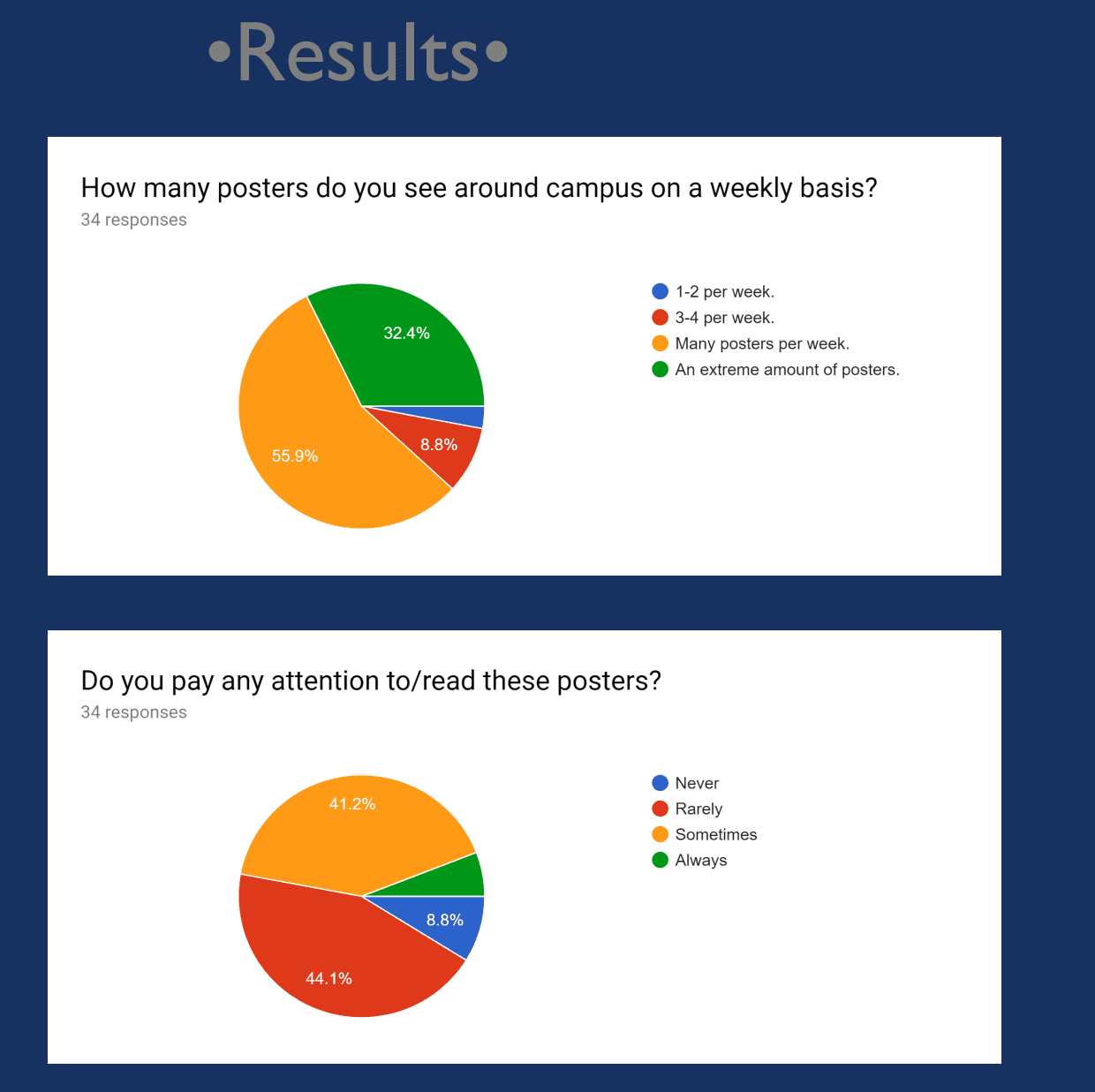
To reduce potential researcher and sampling bias from my early observations and interviews, I triangulated the findings with secondary research from North American universities and colleges.
To reduce potential researcher and sampling bias from my early observations and interviews, I triangulated the findings with secondary research from North American universities and colleges.
To reduce potential researcher and sampling bias from my early observations and interviews, I triangulated the findings with secondary research from North American universities and colleges.


Forums
Forums
Forums
In online discussions, students say they often avoid scanning QR codes on posters because of security concerns and instead prefer Instagram and other social apps, and some students even ask how to stop others from tearing down their posters.
In online discussions, students say they often avoid scanning QR codes on posters because of security concerns and instead prefer Instagram and other social apps, and some students even ask how to stop others from tearing down their posters.
In online discussions, students say they often avoid scanning QR codes on posters because of security concerns and instead prefer Instagram and other social apps, and some students even ask how to stop others from tearing down their posters.
Articles
Articles
Articles
Highlight issues such as information overload, outdated content, design and printing costs, and the manual work of taking posters down.
Highlight issues such as information overload, outdated content, design and printing costs, and the manual work of taking posters down.
Highlight issues such as information overload, outdated content, design and printing costs, and the manual work of taking posters down.
Sierra College (Report)
Sierra College (Report)
Sierra College (Report)
Bulletin boards are rated as one of the least effective ways to communicate on campus.
Bulletin boards are rated as one of the least effective ways to communicate on campus.
Bulletin boards are rated as one of the least effective ways to communicate on campus.
Western Washington University (Survey)
Western Washington University (Survey)
Western Washington University (Survey)
52.9% of students report that they rarely or never read posters.
52.9% of students report that they rarely or never read posters.
52.9% of students report that they rarely or never read posters.
Stanford University (Interviews)
Stanford University (Interviews)
Stanford University (Interviews)
Posters are seen as “just paper waste,” while social media is viewed as a more effective way to share information.
Posters are seen as “just paper waste,” while social media is viewed as a more effective way to share information.
Posters are seen as “just paper waste,” while social media is viewed as a more effective way to share information.
Thompson Rivers University (Focus Group)
Thompson Rivers University (Focus Group)
Thompson Rivers University (Focus Group)
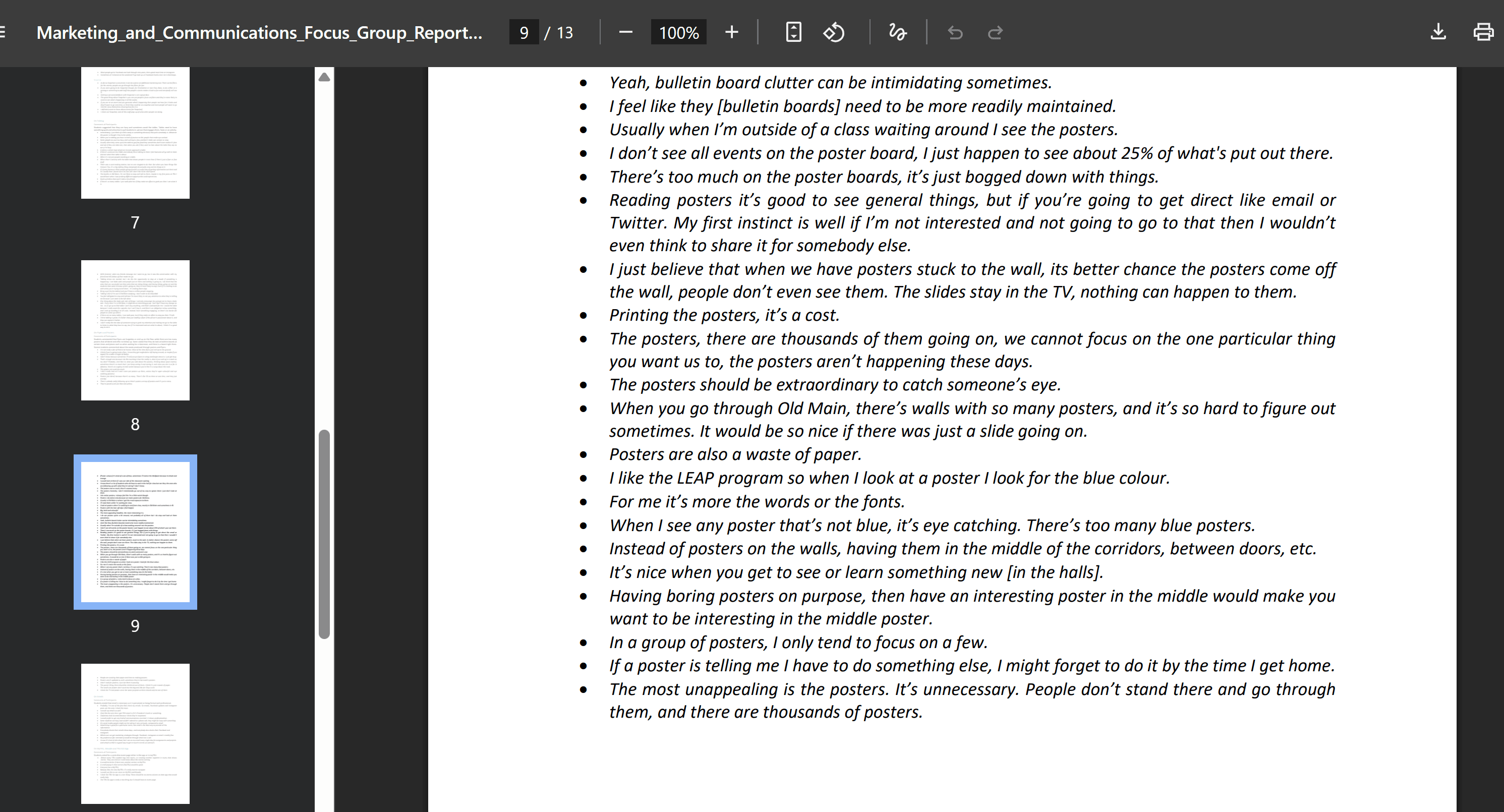
Bulletin boards are described as “intimidating clutter” with “thousands” of posters, and students say they pay more attention to Instagram.
Bulletin boards are described as “intimidating clutter” with “thousands” of posters, and students say they pay more attention to Instagram.
Bulletin boards are described as “intimidating clutter” with “thousands” of posters, and students say they pay more attention to Instagram.
Triangulation and Opportunity
Triangulation and Opportunity
Triangulation and Opportunity
After triangulating the findings, I saw an opportunity for a campus-only, mobile-first social product that includes a low-pressure icebreaker feature, organizes campus info into clear categories, and supports safer connections than open platforms or crowded bulletin boards.
After triangulating the findings, I saw an opportunity for a campus-only, mobile-first social product that includes a low-pressure icebreaker feature, organizes campus info into clear categories, and supports safer connections than open platforms or crowded bulletin boards.
After triangulating the findings, I saw an opportunity for a campus-only, mobile-first social product that includes a low-pressure icebreaker feature, organizes campus info into clear categories, and supports safer connections than open platforms or crowded bulletin boards.
Field Observations
Field Observations
Field Observations
Interviews
Interviews
Interviews
Secondary Research
Secondary Research
Secondary Research

Design Decisions
Design Decisions
Design Decisions
Campus-Only
Campus-Only
Campus-Only
Require school-email sign-in to keep listings campus-only and verified.
Require school-email sign-in to keep listings campus-only and verified.
Require school-email sign-in to keep listings campus-only and verified.
Low-Effort Posting
Low-Effort Posting
Low-Effort Posting
Reduce posting to a few guided mobile steps, replacing the complex “design - print - pin” workflow.
Reduce posting to a few guided mobile steps, replacing the complex “design - print - pin” workflow.
Reduce posting to a few guided mobile steps, replacing the complex “design - print - pin” workflow.
Clear, Categorized Campus Board
Clear, Categorized Campus Board
Clear, Categorized Campus Board
se clear categories and search to support fast, relevant scanning.
se clear categories and search to support fast, relevant scanning.
se clear categories and search to support fast, relevant scanning.
Open Discussion Space
Open Discussion Space
Open Discussion Space
Provides a casual campus space for sharing, asking questions, and replying about everyday campus life or moods, creating an easy icebreaker to meet new people.
Provides a casual campus space for sharing, asking questions, and replying about everyday campus life or moods, creating an easy icebreaker to meet new people.
Provides a casual campus space for sharing, asking questions, and replying about everyday campus life or moods, creating an easy icebreaker to meet new people.
Sitemap
Sitemap
Sitemap

Key User Flow
Key User Flow
Key User Flow

Concept Evaluation & Design Direction
Concept Evaluation & Design Direction
Concept Evaluation & Design Direction
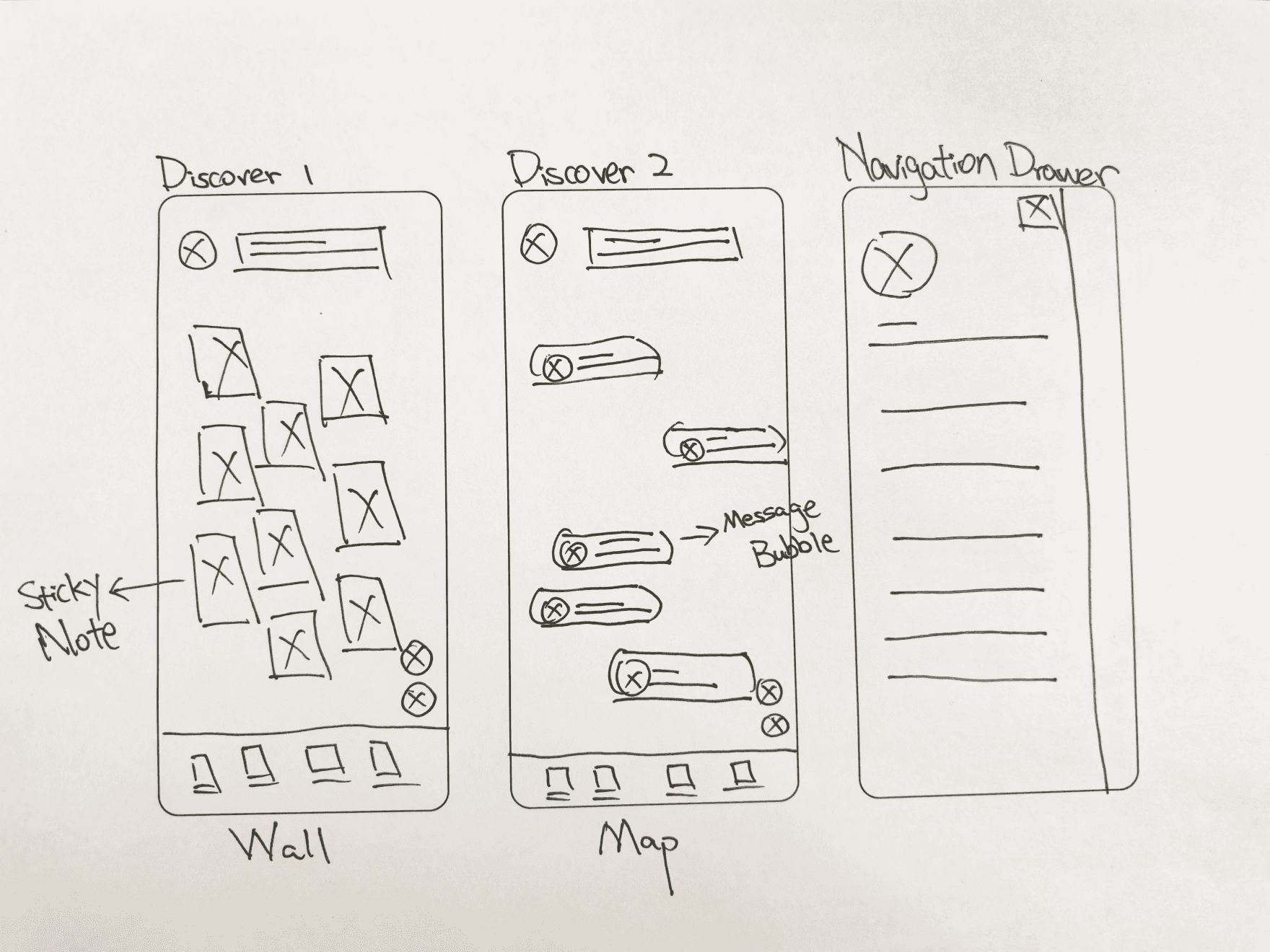
As a key product differentiator, I designed an Open Discussion Space that creates a low-pressure icebreaker for meeting new people, and in the early concept stage I explored two initial homepage concepts:
As a key product differentiator, I designed an Open Discussion Space that creates a low-pressure icebreaker for meeting new people, and in the early concept stage I explored two initial homepage concepts:
As a key product differentiator, I designed an Open Discussion Space that creates a low-pressure icebreaker for meeting new people, and in the early concept stage I explored two initial homepage concepts:
Concept 1. Home page as a sticky-note wall where students post short messages.
Concept 1. Home page as a sticky-note wall where students post short messages.
Concept 1. Home page as a sticky-note wall where students post short messages.
Concept 2. Home page as a campus map where students share thoughts as message bubbles pinned to locations.
Concept 2. Home page as a campus map where students share thoughts as message bubbles pinned to locations.
Concept 2. Home page as a campus map where students share thoughts as message bubbles pinned to locations.
After comparing both concepts, I chose a campus map for the Open Discussion page because it matches students’ mental model of “Where am I?” and “Where is this happening?” and feels more situational and campus-aligned than a single “wall” layout.
After comparing both concepts, I chose a campus map for the Open Discussion page because it matches students’ mental model of “Where am I?” and “Where is this happening?” and feels more situational and campus-aligned than a single “wall” layout.
After comparing both concepts, I chose a campus map for the Open Discussion page because it matches students’ mental model of “Where am I?” and “Where is this happening?” and feels more situational and campus-aligned than a single “wall” layout.
Mid-Fi Prototype Testing
Mid-Fi Prototype Testing
Mid-Fi Prototype Testing
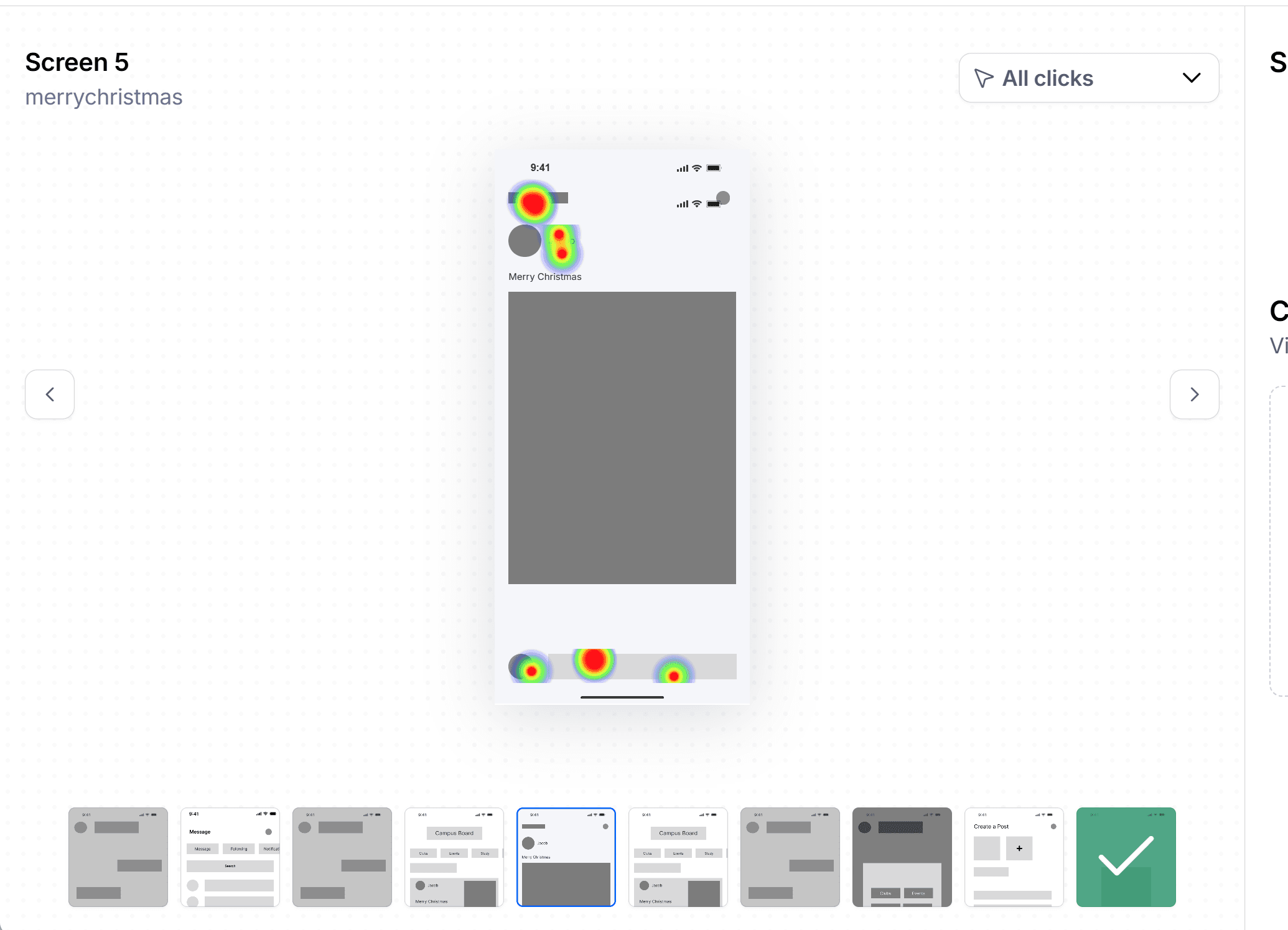
After finalizing the wireframe direction, I built mid-fidelity screens from the user flow and tested them with 8 students. They successfully completed the posting and replying tasks, and their taps matched the intended flow.
After finalizing the wireframe direction, I built mid-fidelity screens from the user flow and tested them with 8 students. They successfully completed the posting and replying tasks, and their taps matched the intended flow.
After finalizing the wireframe direction, I built mid-fidelity screens from the user flow and tested them with 8 students. They successfully completed the posting and replying tasks, and their taps matched the intended flow.
Hi-Fi Design Iteration
Hi-Fi Design Iteration
Hi-Fi Design Iteration
Map Style & Post Visibility
Map Style & Post Visibility
Map Style & Post Visibility
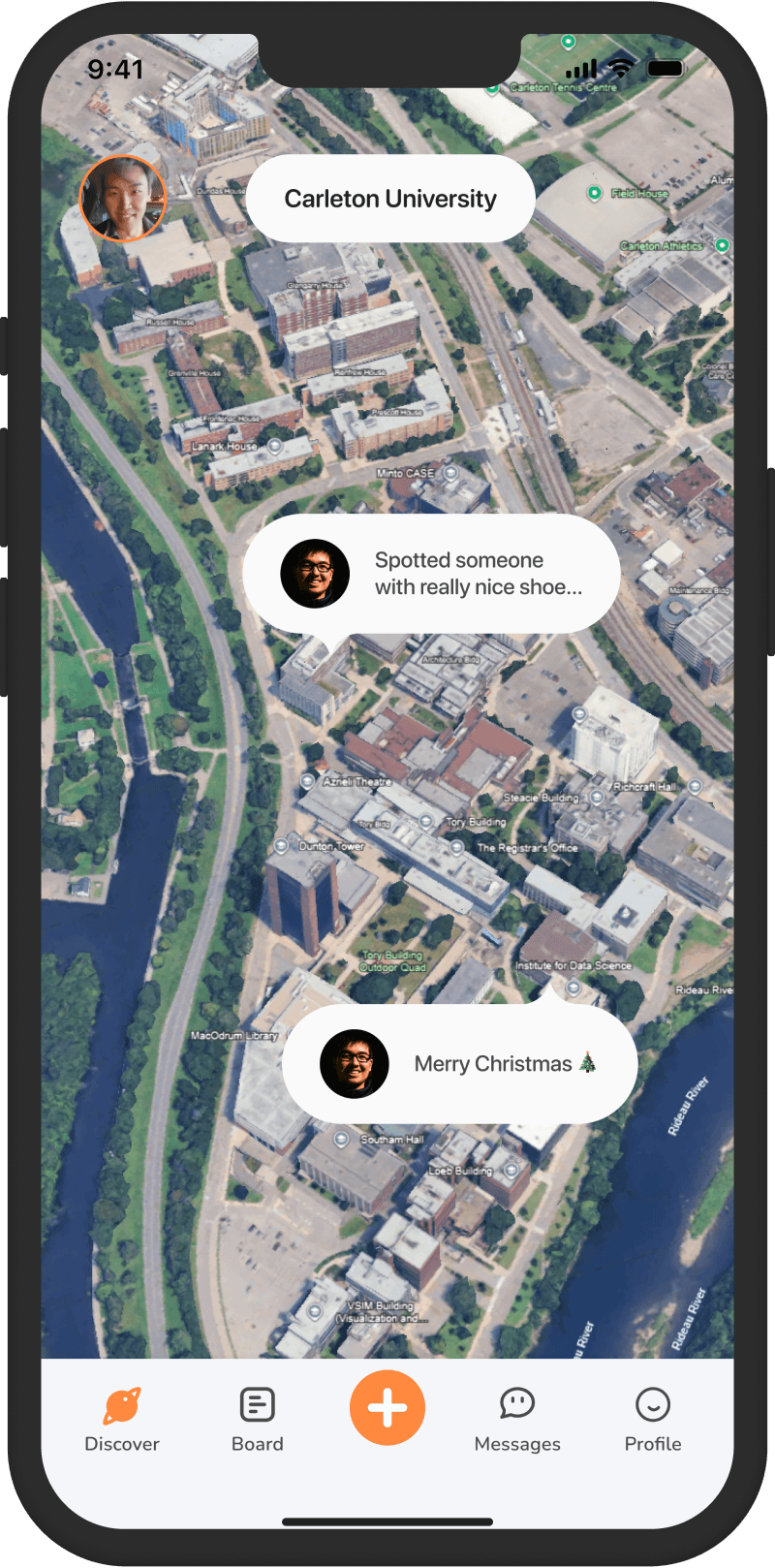
V1
V1
V1
For the homepage icebreaker feature area, I started with a satellite map to make the campus feel real and familiar, but the heavy photo texture added visual noise, made the UI feel muddy and dated, and pulled attention away from the content.
For the homepage icebreaker feature area, I started with a satellite map to make the campus feel real and familiar, but the heavy photo texture added visual noise, made the UI feel muddy and dated, and pulled attention away from the content.
For the homepage icebreaker feature area, I started with a satellite map to make the campus feel real and familiar, but the heavy photo texture added visual noise, made the UI feel muddy and dated, and pulled attention away from the content.
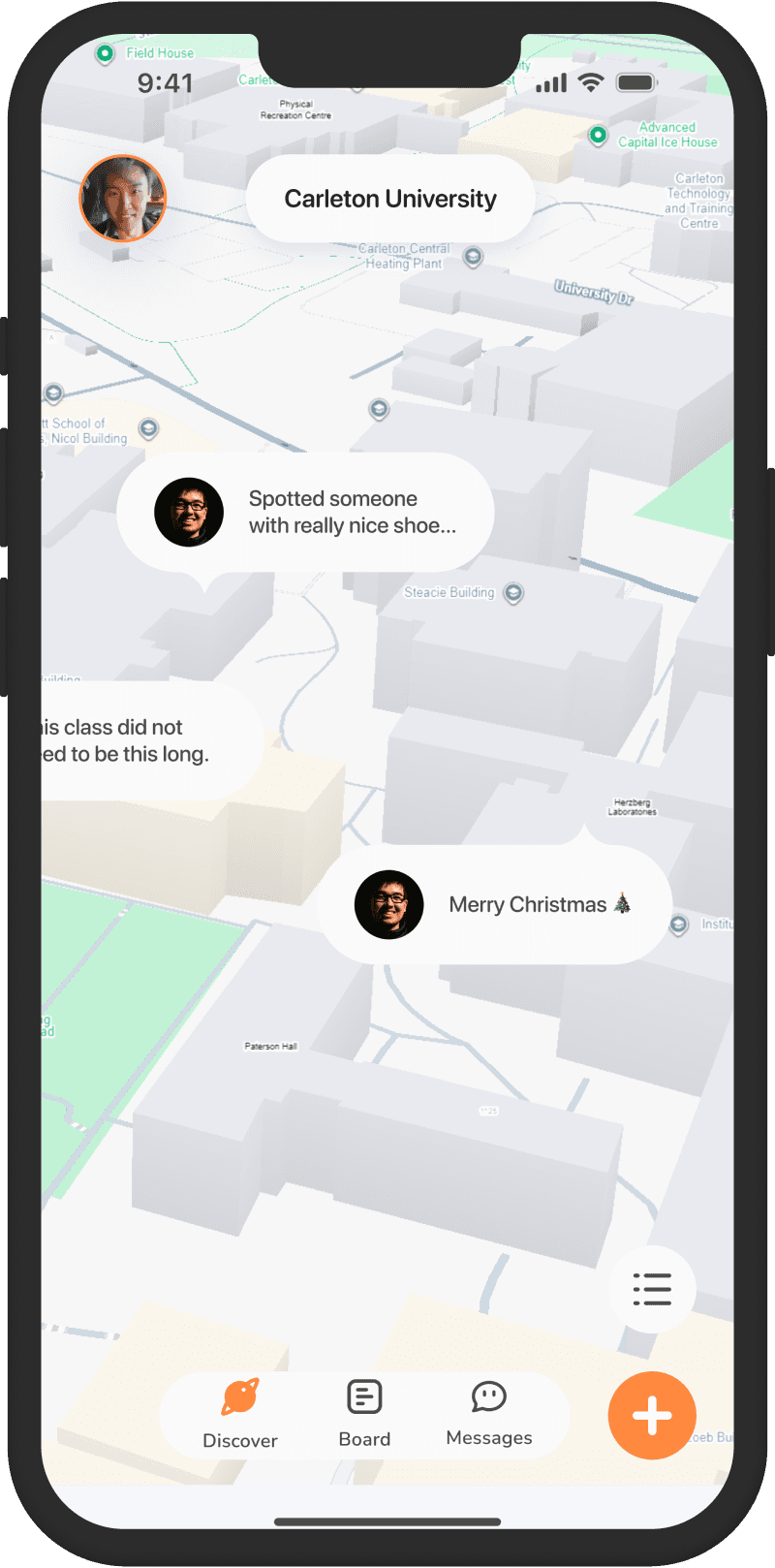
V2
V2
V2
I switched to a vector map to achieve a cleaner, more modern look, which removed the “dirty” feel. However, the post bubbles visually blended into the map, placing content and background at the same level and weakening the visual hierarchy.
I switched to a vector map to achieve a cleaner, more modern look, which removed the “dirty” feel. However, the post bubbles visually blended into the map, placing content and background at the same level and weakening the visual hierarchy.
I switched to a vector map to achieve a cleaner, more modern look, which removed the “dirty” feel. However, the post bubbles visually blended into the map, placing content and background at the same level and weakening the visual hierarchy.
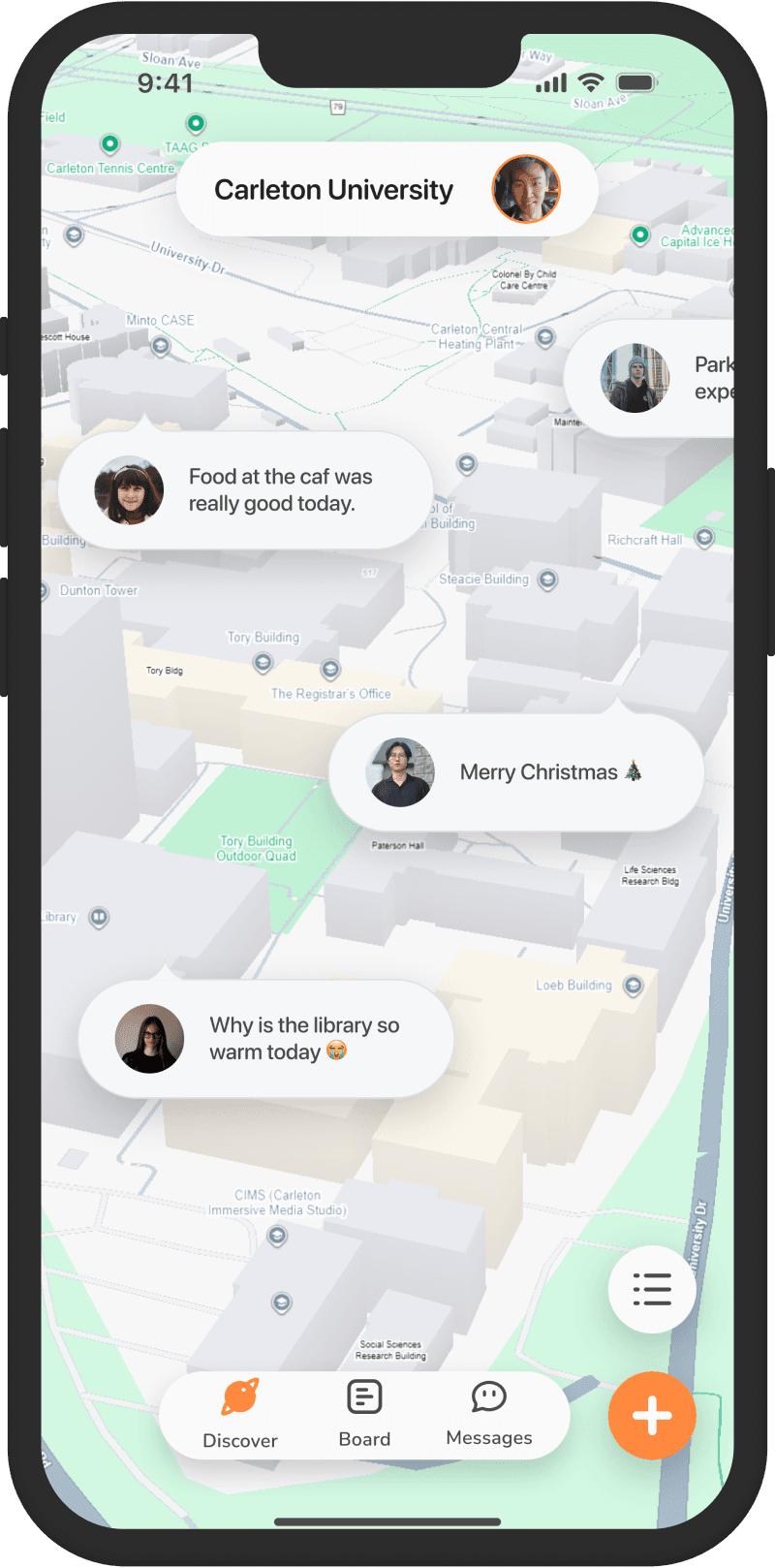
Final Design
Final Design
Final Design
After several iterations, I found that changing the bubble colors improved clarity, but darker bubbles still looked muddy against the light map.
After several iterations, I found that changing the bubble colors improved clarity, but darker bubbles still looked muddy against the light map.
After several iterations, I found that changing the bubble colors improved clarity, but darker bubbles still looked muddy against the light map.
In the end, I added the stroke and shadow to the post bubbles to create clearer separation and restore visual hierarchy.
In the end, I added the stroke and shadow to the post bubbles to create clearer separation and restore visual hierarchy.
In the end, I added the stroke and shadow to the post bubbles to create clearer separation and restore visual hierarchy.
Now, message bubbles are the primary visual layer, while the map sits in the background as a secondary layer that provides location context without distracting from the content.
Now, message bubbles are the primary visual layer, while the map sits in the background as a secondary layer that provides location context without distracting from the content.
Now, message bubbles are the primary visual layer, while the map sits in the background as a secondary layer that provides location context without distracting from the content.
Card Redesign
Card Redesign
Card Redesign
Before
Before
Before
After
After
After
Before
After
Before
After
Before
After
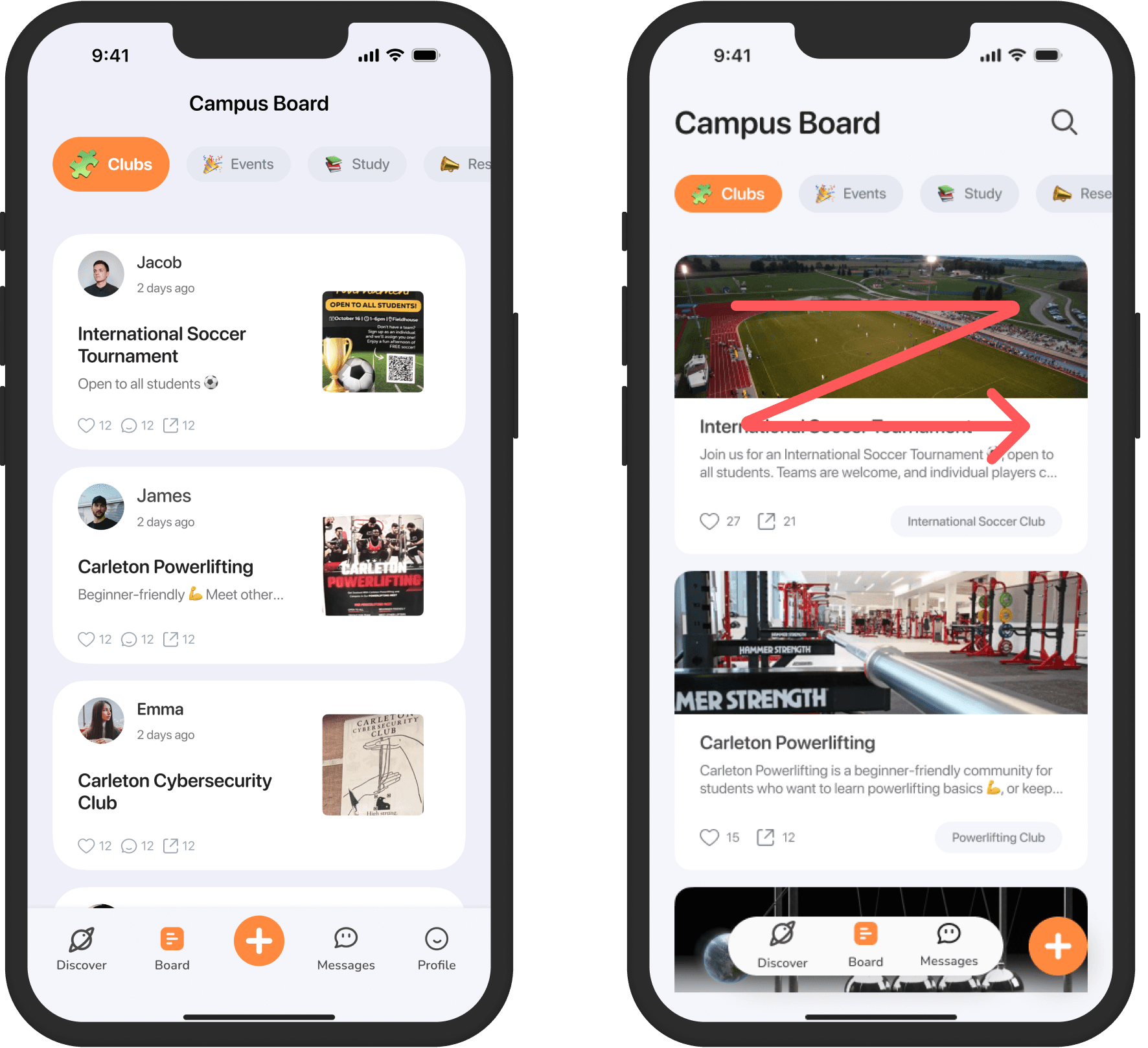
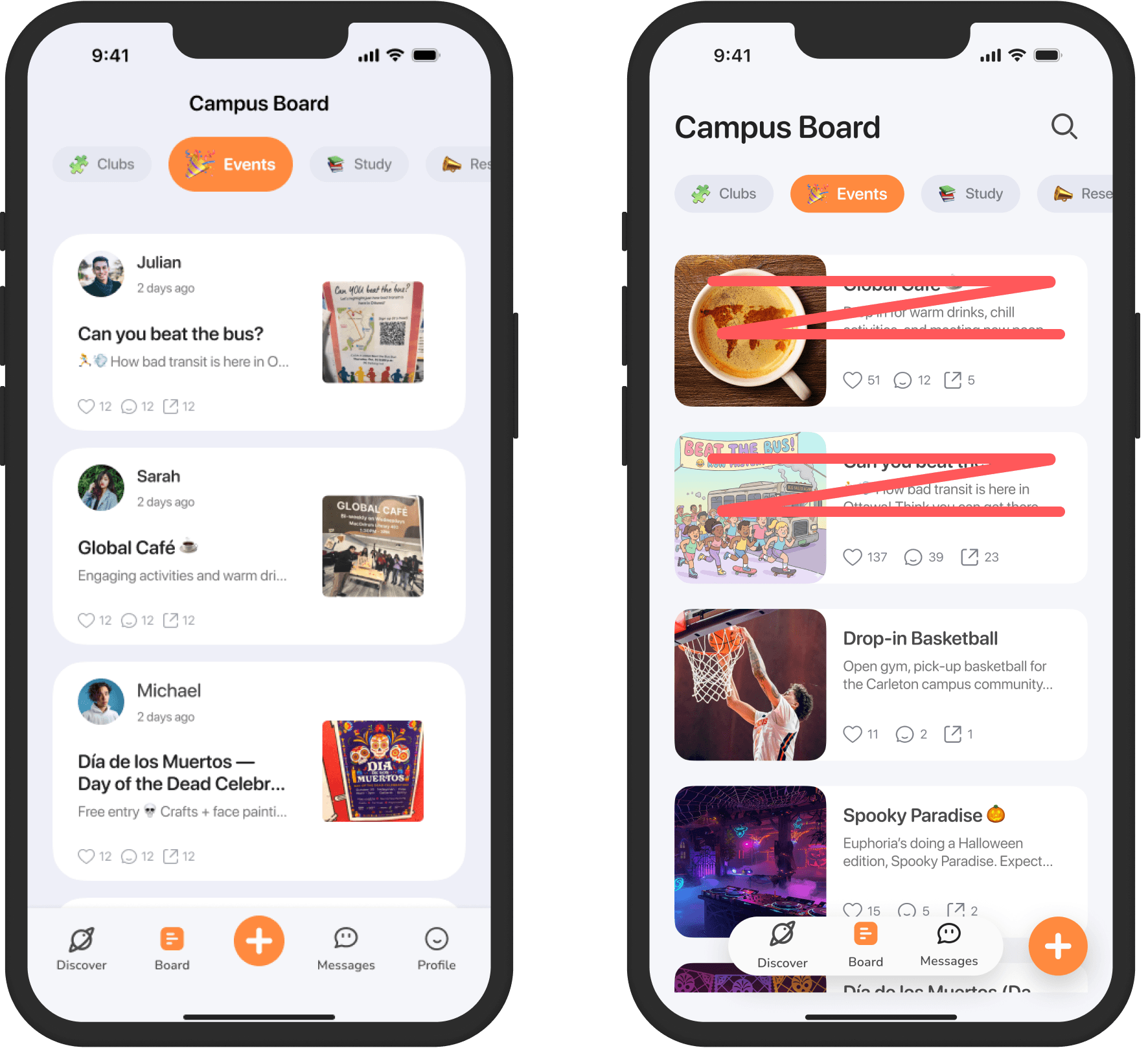
After the first version of the Clubs and Events feed, I reviewed it and reflected on what students actually focus on when browsing.
After the first version of the Clubs and Events feed, I reviewed it and reflected on what students actually focus on when browsing.
After the first version of the Clubs and Events feed, I reviewed it and reflected on what students actually focus on when browsing.
I realized students don’t care who posted an event, they care whether it looks interesting and relevant. This aligned with my interview findings, posters often grab attention with an eye-catching image, so when scanning, people look at the image first and the text second.
I realized students don’t care who posted an event, they care whether it looks interesting and relevant. This aligned with my interview findings, posters often grab attention with an eye-catching image, so when scanning, people look at the image first and the text second.
I realized students don’t care who posted an event, they care whether it looks interesting and relevant. This aligned with my interview findings, posters often grab attention with an eye-catching image, so when scanning, people look at the image first and the text second.
Based on user scan behavior, I refined the card design by removing the poster’s avatar and name to reduce distraction, and by prioritizing the image and key text with a clearer visual hierarchy.
Based on user scan behavior, I refined the card design by removing the poster’s avatar and name to reduce distraction, and by prioritizing the image and key text with a clearer visual hierarchy.
Based on user scan behavior, I refined the card design by removing the poster’s avatar and name to reduce distraction, and by prioritizing the image and key text with a clearer visual hierarchy.
Navigation Hierarchy Refinement
Navigation Hierarchy Refinement
Navigation Hierarchy Refinement

After iterating on the Campus Board page, I realized the enlarged selected tab in the top navigation was competing with the board content. I reverted the selected tab to the same size and kept the active state clear, so attention stays on the posts and the visual hierarchy is stronger.
After iterating on the Campus Board page, I realized the enlarged selected tab in the top navigation was competing with the board content. I reverted the selected tab to the same size and kept the active state clear, so attention stays on the posts and the visual hierarchy is stronger.
After iterating on the Campus Board page, I realized the enlarged selected tab in the top navigation was competing with the board content. I reverted the selected tab to the same size and kept the active state clear, so attention stays on the posts and the visual hierarchy is stronger.

After reviewing the navigation, I removed Profile from the bottom bar and moved it into a left-side drawer that opens from a top entry. I kept the bottom nav focused on core actions of Discover, Board, and Messages, and I gave the Post button a dedicated spot since posting is a primary action in the product, so the map is less blocked and users stay focused on the main experience.
After reviewing the navigation, I removed Profile from the bottom bar and moved it into a left-side drawer that opens from a top entry. I kept the bottom nav focused on core actions of Discover, Board, and Messages, and I gave the Post button a dedicated spot since posting is a primary action in the product, so the map is less blocked and users stay focused on the main experience.
After reviewing the navigation, I removed Profile from the bottom bar and moved it into a left-side drawer that opens from a top entry. I kept the bottom nav focused on core actions of Discover, Board, and Messages, and I gave the Post button a dedicated spot since posting is a primary action in the product, so the map is less blocked and users stay focused on the main experience.
High-Fidelity Design
High-Fidelity Design
High-Fidelity Design

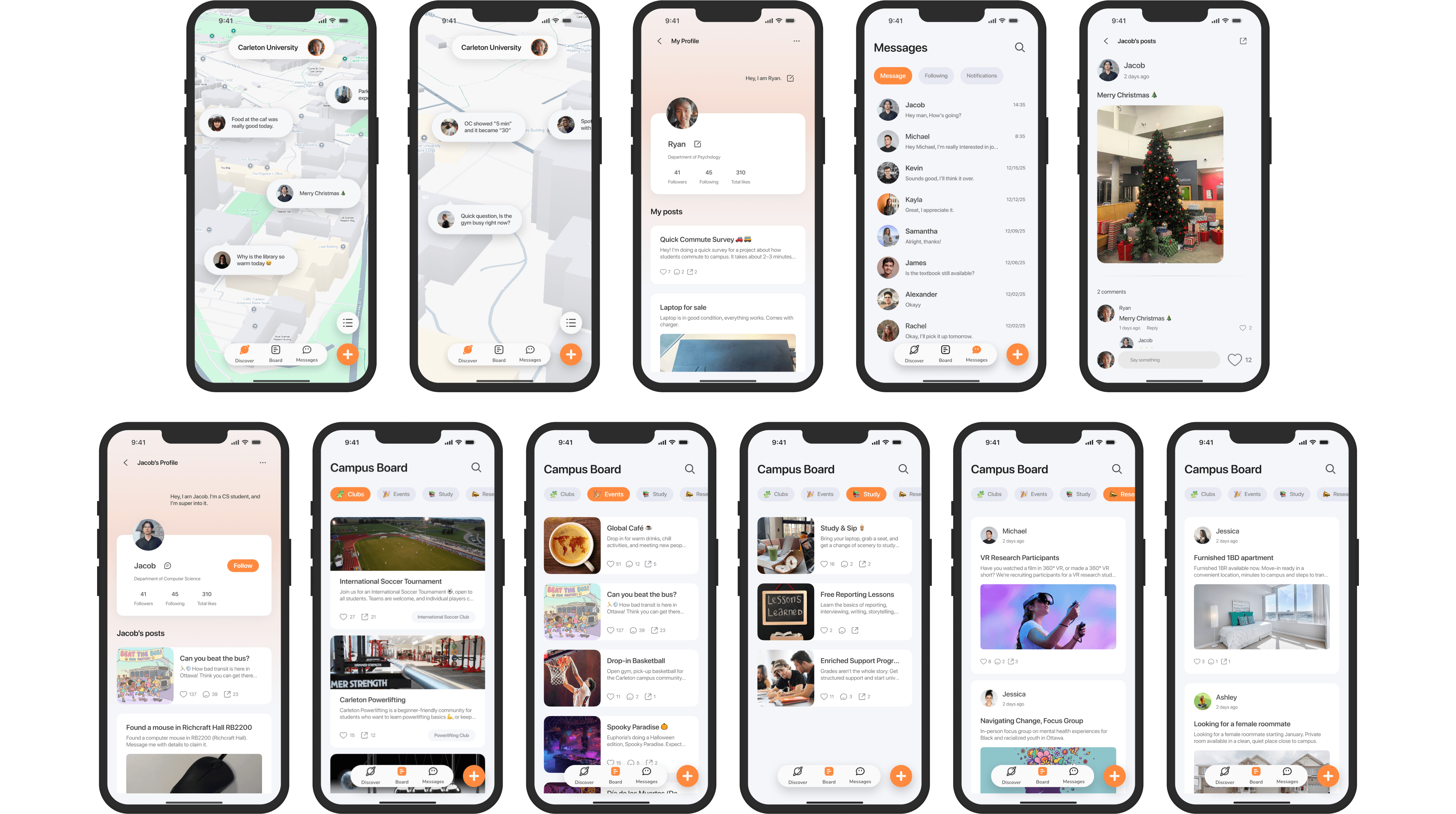
I designed the Home screen as a casual space for short posts and replies. Students can tap map bubbles to open a post and comment, or create their own post and pin it on the campus map, making it easy to start conversations and meet new people on campus.
I designed the Home screen as a casual space for short posts and replies. Students can tap map bubbles to open a post and comment, or create their own post and pin it on the campus map, making it easy to start conversations and meet new people on campus.
I designed the Home screen as a casual space for short posts and replies. Students can tap map bubbles to open a post and comment, or create their own post and pin it on the campus map, making it easy to start conversations and meet new people on campus.
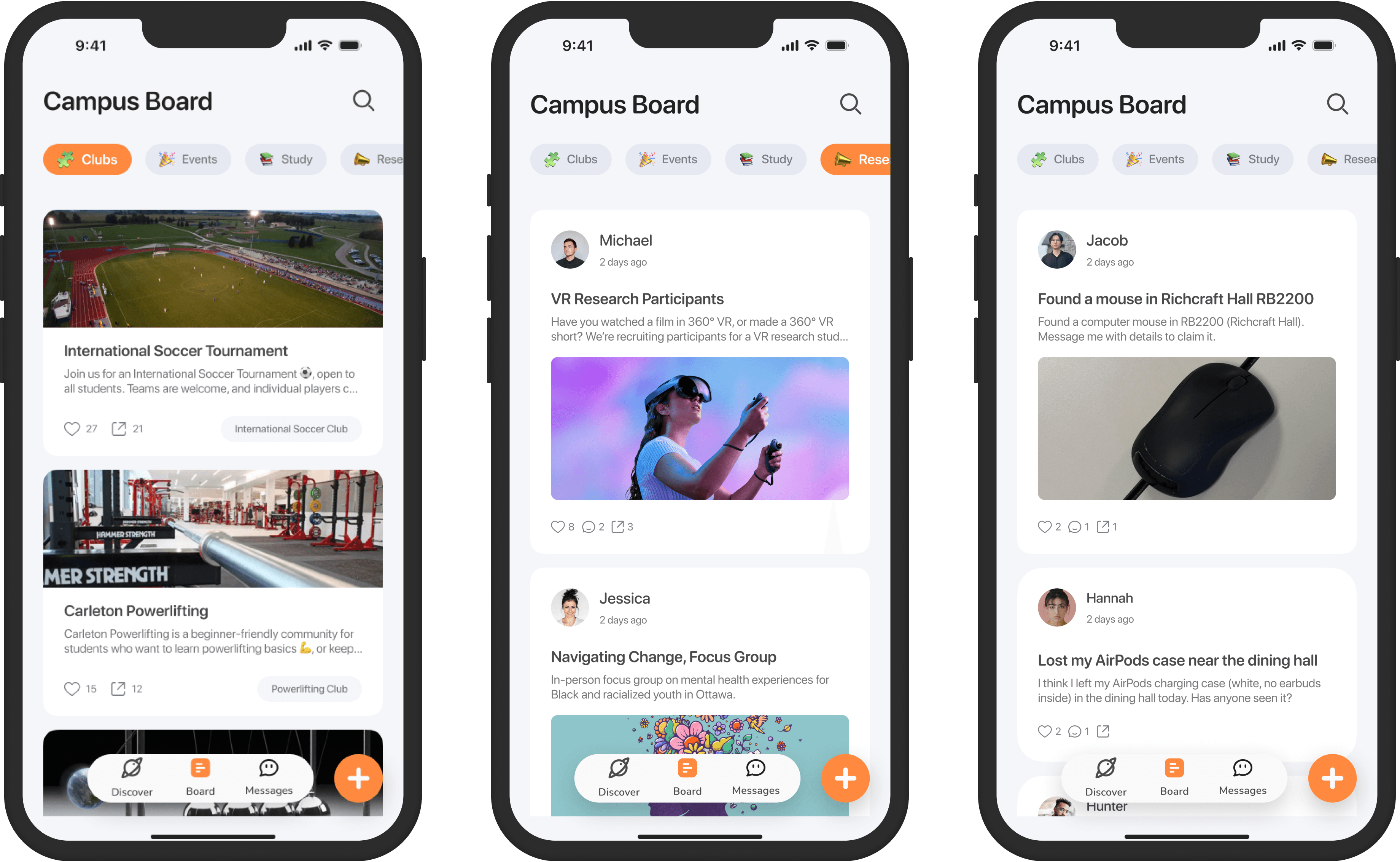
I turned the messy physical bulletin board into a clean, structured feed with filters, search, and low-effort posting. This lets students quickly scan and find what they care about without relying on the physical board, even when they’re off campus.
I turned the messy physical bulletin board into a clean, structured feed with filters, search, and low-effort posting. This lets students quickly scan and find what they care about without relying on the physical board, even when they’re off campus.
I turned the messy physical bulletin board into a clean, structured feed with filters, search, and low-effort posting. This lets students quickly scan and find what they care about without relying on the physical board, even when they’re off campus.
Final High-Fi Screens
Final High-Fi Screens
Final High-Fi Screens
Final Prototype
Final Prototype
Final Prototype
If I have more time...
If I have more time...
If I have more time...
Run a quick early survey to more directly validate the key problems and hypotheses.
Run a quick early survey to more directly validate the key problems and hypotheses.
Run a quick early survey to more directly validate the key problems and hypotheses.
Improve trust and safety for housing and the marketplace by designing reporting and blocking flows, making the campus community safer and more trustworthy.
Improve trust and safety for housing and the marketplace by designing reporting and blocking flows, making the campus community safer and more trustworthy.
Improve trust and safety for housing and the marketplace by designing reporting and blocking flows, making the campus community safer and more trustworthy.